
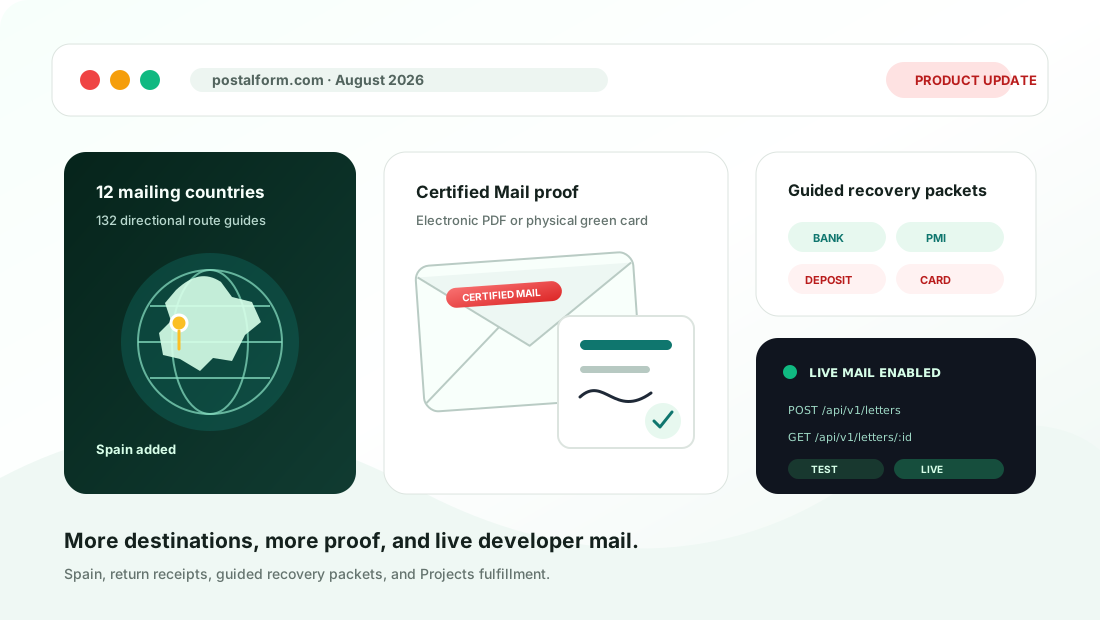
August expanded what PostalForm can send, what proof customers can request, and how software can use the same mailing infrastructure.
The largest changes were international: Spain joined the supported mailing network, and the international guide library grew from country summaries into route-specific instructions. Certified Mail also gained more complete Return Receipt handling, while four guided consumer packets moved into the public forms catalog.
Spain joined the supported mailing network
PostalForm now supports mailing to Spain across postalform.com, PostalForm Projects, machine orders, and the published API schemas.
That brings the supported destination list to 12 countries:
- United States and Canada.
- Austria, Belgium, France, Germany, Luxembourg, the Netherlands, Spain, and Switzerland.
- United Kingdom and India.
Spanish destinations use the same core review boundary as every other order: add the real sender and recipient, upload or generate the document, see the eligible services and exact price, then pay only after the mailing is correct.
The international mailing library also added 132 origin-to-destination guides covering every directional pair among those 12 markets. A guide can now explain the route from one specific country to another, compare the online and local-post paths, show destination address requirements, and carry the recipient country into the upload flow without guessing the sender’s location.
More complete Certified Mail proof options
Certified Mail customers and API users gained a more explicit set of receipt choices.
For eligible U.S. Certified Mail, PostalForm now supports:
- Electronic Return Receipt as a signed USPS PDF.
- Physical PS Form 3811, the mailed green card.
- Restricted Delivery for addressee-only delivery where supported.
- Manual electronic-receipt retrieval or automatic email delivery when the receipt becomes available.
PostalForm Projects exposes the same choices in quotes and orders. Developers can see receipt status separately from the ordinary tracking timeline, download an acquired receipt PDF, or export available receipts as a ZIP with a CSV manifest. Electronic receipts are retained for three years by default in Projects.
The customer-facing Certified Mail pages and upload handoff were also tightened for smaller screens. Delivery estimates, tracking chronology, and returned-mail language now distinguish more clearly between acceptance, in-transit events, delivery, and a piece being returned.
Four new consumer recovery and dispute packets
August added four focused workflows to the forms catalog:
- The Bank Fraud Claim and Unauthorized Transfer Dispute Packet documents an electronic-transfer error after the account holder has reported it promptly to the bank. It supports a first written notice, a requested written confirmation, or a request for investigation records after denial.
- The PMI Cancellation Request Packet supports a narrow original-value request or a request for the servicer’s current-value evaluation rules, with the mortgage facts and supporting copies organized for Certified Mail.
- The Security Deposit Recovery Packet builds a state-aware demand letter, facts summary, exhibit index, and evidence packet. It can prepare separate Certified Mail copies for a landlord, property manager, and registered agent when the customer has reliable addresses.
- The Credit Card Billing Error and Denied-Dispute Packet prepares a signed billing-error notice or careful post-denial response with a timeline, exhibit index, redacted supporting copies, and required Certified Mail.
PostalForm also added fixed-recipient letter workflows for selected elected officials, authors, entertainers, and members of the British royal family. Those pages keep the sourced destination fixed through checkout, while the writer can edit and preview the letter itself. Mailing never guarantees personal readership or a reply.
Five new research-backed guides explain USPS Forms 1094, 3811-A, and 3877, plus SSA Forms 2458 and 8007. They clarify what PostalForm can mail versus what the issuing agency must prepare, verify, or decide.
PostalForm Projects moved from testing to live mail
On August 18, PostalForm Projects enabled live fulfillment.
Projects workspaces can keep using free simulated test keys, then add prepaid credits and switch deliberately to live credentials when the integration is ready. Live orders use the same document upload, quote, idempotency, status, and signed-webhook model exercised in test mode.
The August release also brought the new international country support and Certified Mail receipt controls into Projects. Failed automatic credit refills now produce a deduplicated customer email that explains that no successful charge or credit addition was recorded and links back to billing settings.
Developer surfaces became easier to connect
The remote MCP transport gained an optional GET/SSE compatibility path for clients that still expect that connection style, while streamable HTTP remains the main integration surface.
The developer guide was also reorganized to separate the main integration choices more clearly: the project-scoped Projects API for persistent server integrations, reviewable hosted-checkout drafts for user-facing assistants, and MPP or x402 only for autonomous runtimes with explicit payment authority and spend controls.
Fewer dead ends in long form sessions
Long form sessions now recover more gracefully when a CSRF token expires. PostalForm can refresh the session protocol and retry the failed request once, which prevents a stale browser tab from simply dumping a customer out of a completed form or preview.
International address handling was also strengthened for non-ASCII return addresses and European postal layouts, while uploaded PDFs with unusual crop-box metadata are normalized more consistently before preview and fulfillment.
Finally, the resources hub was rebuilt around practical jobs such as preparing a document, choosing a mailing service, finding a government form, solving a dispute, or connecting an API.
August closed with a broader product, but also a more legible one: more countries, more proof choices, more narrowly scoped guided packets, and a cleaner boundary between test mail, reviewed mail, and fully authorized machine-paid work.